One system for everything: why museums choose integrated ticketing
Timed entry, group bookings, venue hire and a café till all living in their own world: for many museums that is daily reality. How one integrated system changes that.
How to keep overview in a multifunctional building where your own programming, rentals, rehearsals and library activities all come together. Practical tips for planners.
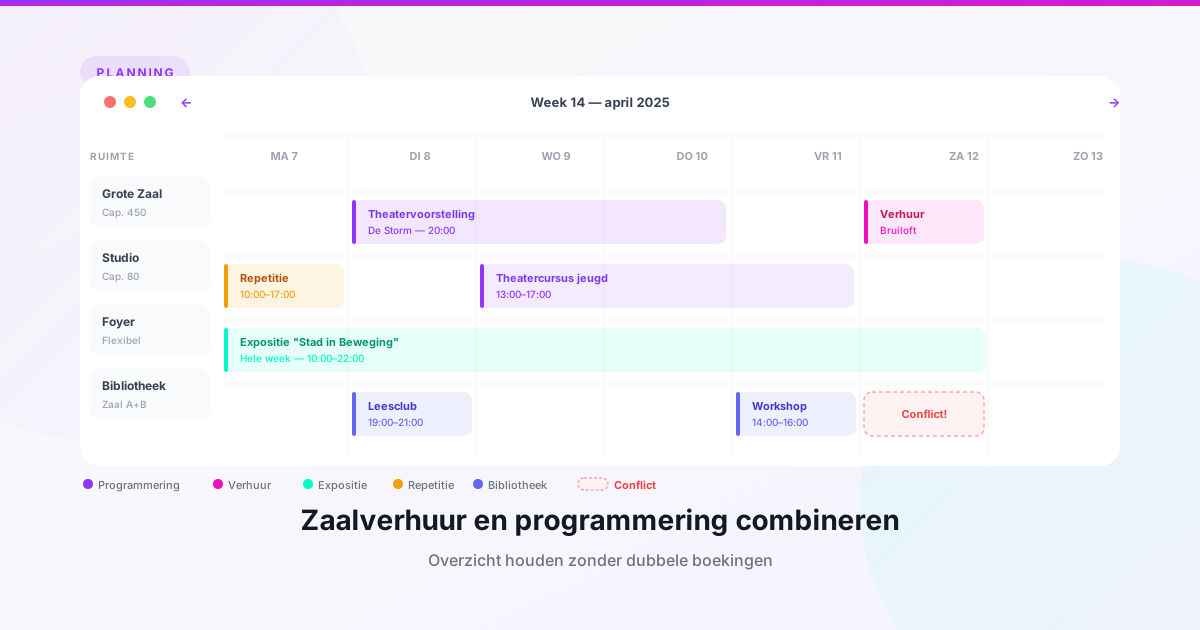
A theatre hall rented out in the morning to a company for a presentation, which then needs to be available in the afternoon for the build-up of an evening performance, while a rehearsal takes place in the small hall and the library on the ground floor is simply open. Sound familiar? For planners in multifunctional cultural buildings, this is daily reality.
Combining your own programming with venue rental is one of the most complex puzzles in managing a cultural building. In this article we share practical insights for planners who deal with this every day.
A multifunctional building combines functions that each have their own rhythm. Theatre performances are programmed months in advance. Venue rental requests often come in at shorter notice. Library activities run on fixed times. Film screenings follow their own schedule. And in between there are rehearsals, build-up, break-down and maintenance.
It’s not enough to say “the performance is in Hall A this week.” You’re dealing with multiple groups sharing the same space on the same day, walkthroughs that need to be scheduled, and rehearsals in one hall while another is being set up. Add to that the spaces that aren’t official halls but still need just as much coordination: the loading dock, the foyer, the dressing rooms, the scenery store.
Most organisations apply a clear hierarchy: their own artistic programming takes precedence. Only once the season is planned do the remaining slots open up for rental. This sounds simple, but in practice performances shift, extra performance times are added, and a hall sometimes needs to be freed up at the last minute.
A workable model looks like this. In phase 1 (six to twelve months ahead) you programme the season: the major productions, series and fixed collaborations. In phase 2 (three to six months ahead) you fill the gaps: extra programming, one-off performances, guest programming. In phase 3 (ongoing) you open remaining availability for rental.
It helps to publish a “availability calendar” per hall that updates automatically based on your planning. That way you don’t need to manually communicate what’s free.
In an ideal world, every hall has exactly one activity at any given time. In practice, you often want to hold multiple options simultaneously. A producer who’s interested but hasn’t confirmed yet. A rental enquiry coming in for a date you’re still undecided about. An internal event that might be moved.
It’s essential that your planning system allows conflicts — not as an error, but as a deliberate choice. You want to be able to see: on this date there are three options, two are pencilled in and one is confirmed. When you confirm, the other options disappear or are marked as declined. This lets you plan flexibly without having to reject enquiries before you’ve made a final decision.
This is fundamentally different from a simple diary where you can only enter confirmed bookings. The planning phase is inherently uncertain, and your system must be able to record that uncertainty.
Many organisations still work with a mailbox full of rental enquiries. Someone sends an email saying “I’d like the large hall on 15 March”, the planner manually checks availability, replies with options, the renter responds three days later, and meanwhile that date has already been taken. This process is slow, error-prone and frustrating for everyone involved.
A better approach: publish your available halls and time slots online. Potential renters immediately see what’s free, can submit an enquiry with all necessary information (type of event, expected number of attendees, required facilities), and the planner reviews and confirms from within the planning system. The renter receives a quote and, after approval, a confirmation.
This has three advantages. First, it saves time: the planner no longer needs to manually email about availability. Second, it prevents errors: availability is always current because it comes directly from the planning. Third, it lowers the threshold: a renter who wants to book a hall at 10 pm doesn’t have to wait until office hours.
A rental is more than a space and a time. For a company presentation in the theatre hall you may need a technician for lighting and sound. For a reception in the foyer the bar needs to be staffed. For a rehearsal by an amateur group the dressing rooms need to be available.
If these resources and staff are in the same system as your hall planning, you prevent conflicts that you’d otherwise only discover on the day itself. The technician double-booked because the rental was in a different system. The bar unstaffed because no one passed on the message. The loading dock blocked by a delivery while scenery needs to be brought in.
The principle is simple: your planning is your single source of truth. Everyone looks at the same information, from the programmer to the technical department to catering. No separate lists, no individual spreadsheets per department.
The planning is only complete when there’s a runbook for the day itself. Who opens the building? When does the technician arrive? What time does the soundcheck begin? Where is catering happening? Who are the contact persons?
In a multifunctional building, on a busy day multiple runbooks run alongside each other. The morning rental has different needs than the evening performance. The library has its own opening hours that mustn’t be disrupted by a loading platform being blocked.
If the runbook is directly linked to the planning, you don’t need to enter information twice. A change to the start time of a performance automatically flows through to the runbook, and everyone involved sees the update.
Keep track of what each hall yields: rental income, ticket revenue, and costs (staff, technical, cleaning). This may seem like an accounting matter, but it’s strategic. Because the question “should we rent out the large hall on Thursday afternoon to a company for €800, or keep it free for an extra rehearsal?” can only be answered if you know what both options yield financially.
By tracking income and costs per hall and per activity, you build up a picture over the seasons of which combinations are most profitable. Perhaps you discover that the small hall consistently rents well on Tuesday evenings. Or that the foyer is barely used on Friday afternoons and could therefore be made available.
The biggest source of planning conflicts is not the system but communication. The programmer books an extra performance without telling the rental department. The library plans a large event on the same evening as a theatre premiere. The technical department blocks a hall for maintenance but forgets there’s a rental scheduled.
A shared, central calendar solves this. Not a calendar that everyone maintains separately, but one source that all departments work in. Each department sees the activities of the other departments, even if they don’t have editing rights. This way you discover conflicts before they become problems.
For planners who juggle programming, rental and internal activities every day, these are the five most important principles.
First: plan in phases. Season programming first, then guest programming, then rental. Maintain that order.
Second: allow conflicts. Multiple options on the same date is not an error but a planning phase. Make the status of each option visible.
Third: publish availability online. Let renters see what’s free themselves and submit an enquiry. That saves everyone time.
Fourth: plan not just the hall but also the resources. Technical equipment, staff, catering, dressing rooms. If it’s not in the planning, it goes wrong.
Fifth: work from one shared calendar. Not a separate system per department, but one source of truth that everyone looks at.
A multifunctional building doesn’t have to be a planning nightmare. With the right approach and the right tools it becomes what it should be: a place where everything comes together.
Curious how Ovatic combines planning and venue rental in one system? Request a demo and we’ll show you.
Timed entry, group bookings, venue hire and a café till all living in their own world: for many museums that is daily reality. How one integrated system changes that.
Book a free 30-minute demo tailored to your organisation. No obligations.