As a theatre or performing arts venue, you work with dozens of companies, producers and artists each season. With every performance, the revenue has to be divided — and it goes beyond a simple invoice. How that split looks depends on the type of contract agreement. In this article we explain the three most common models and show where it gets complex in practice.
The basis for these contract models is the umbrella agreement drawn up by the VSCD together with the NAPK (Dutch Association for Performing Arts) and the VVTP (Association of Independent Theatre Producers). This agreement forms the foundation for virtually all contracts between venues and performing companies in the Netherlands.
The three contract models
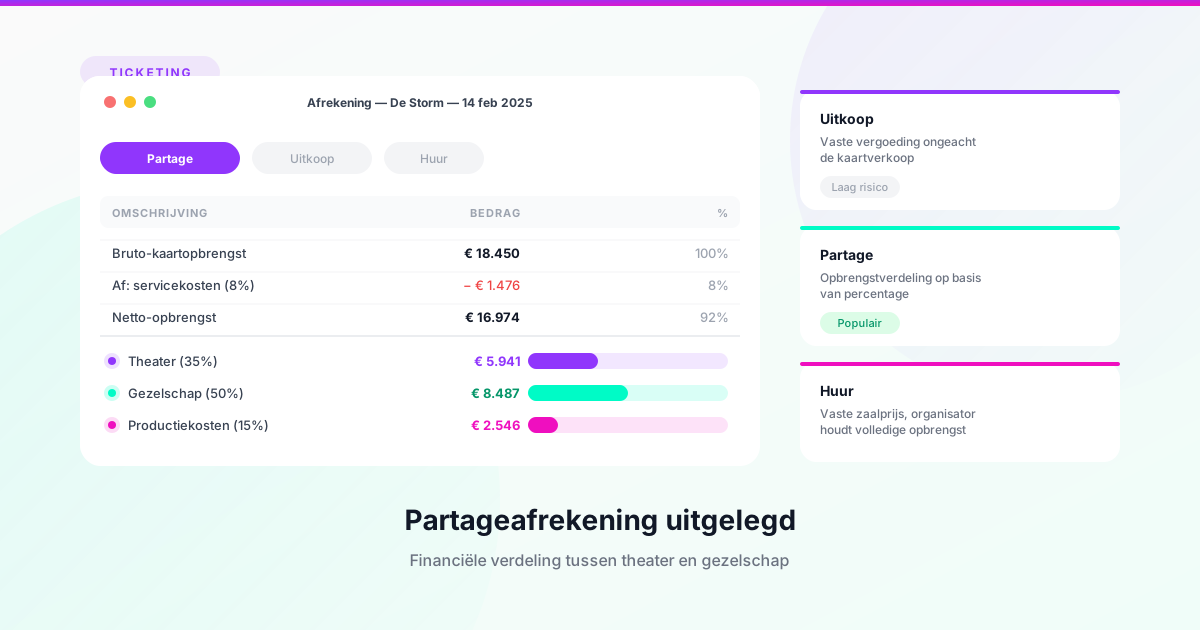
When programming a performance, you agree with the contracting party (the company or producer) how revenues will be divided. In Dutch theatre practice there are three common models, all of which are supported by Ovatic.
Buy-out
The theatre pays a fixed amount to the company, regardless of how many tickets are sold. The theatre bears the full financial risk: when the house is sold out you earn more, but when it’s empty you still pay the full buy-out amount.
When it’s used: for smaller productions, emerging companies, or performances where the theatre deliberately chooses a guaranteed fee for the maker.
Partage
Revenues are divided on the basis of an agreed percentage. For example: 70% for the company and 30% for the theatre, or the other way around. The split is based on the net box office — ticket sales excluding service charges.
Often a guarantee amount is also agreed alongside the partage: a minimum amount the company receives in any case, regardless of ticket sales. Does the performance bring in more than the guarantee? Then the surplus is divided according to the agreed percentage.
When it’s used: for most medium and large productions. This is the most common model in the Dutch theatre sector.
Hire
The company hires the hall for a fixed amount. All revenue from ticket sales goes to the company. The theatre receives only the hire fee and any surcharges for facilities.
When it’s used: for commercial productions that manage their own sales, or for external parties hiring the hall for events.
Where it gets complex
In theory these models are simple. In practice there’s more to it.
Surcharges and service fees
In addition to the basic ticket price, theatres often charge surcharges: cloakroom (for example €2.00 per visitor), a catering surcharge (€3.50 for a welcome drink), booking fees (€2.50 per booking) or a theatre surcharge. These surcharges generally fall outside the partage — they go to the theatre. But you do need to administer this clearly, because the company wants to know exactly how the box office is composed.
In Ovatic you can easily register these surcharges on your performance so they appear transparently and clearly on your settlement.
Tip: regularly check whether your surcharges still cover actual costs. The prices of catering, cloakroom and hospitality services have risen considerably in recent years. A catering surcharge that covered costs five years ago may no longer do so. Factor this in during season preparation.
Copyright and royalty payments
With every performance, copyright fees are owed to rights organisations. The question is: are those copyright fees included in the box office or not?
The most commonly used method under the umbrella agreement is the so-called BUMA method. Here the box office is inclusive of copyright fees and the formula A/(100+A) is applied, where A is the copyright percentage. With a copyright percentage of 10% and a box office of €11,000, the copyright fees are €11,000 × 10/110 = €1,000. The net box office on which the partage is calculated is then €10,000.
The alternative is the Anglo-Saxon method, where the box office is exclusive of copyright fees. The formula is then A/100. With a net box office of €10,000 and 10% copyright, the cost is €10,000 × 10/100 = €1,000.
At high box office figures the difference between these methods adds up. When recording contract terms, always explicitly state which method applies.
Guarantee inclusive or exclusive of copyright fees
This question also arises with the guarantee amount. If the guarantee is inclusive of copyright fees, the gross box office is used to determine whether the guarantee has been reached. If the guarantee is exclusive of copyright fees, the copyright fees are first deducted from the box office and the remainder is compared against the guarantee.
Supplement
Sometimes a supplement arrangement is agreed. This is a guaranteed amount topped up to reach the buy-out sum. The supplement is added to the net box office. If the box office falls short of the agreed buy-out, the difference is made up. Does the box office reach the buy-out? Then the supplement lapses.
Complimentary tickets
With every performance, complimentary tickets are issued — both to the contracting party (for the artistic team, technicians, press) and to the theatre itself. It’s important to track the number of complimentary tickets accurately. The umbrella agreement includes provisions about the maximum number of free seats. If exceeded, the extra complimentary tickets can be included on the invoice so they don’t invisibly reduce the box office.
Deducting costs
If you manage both ticketing and planning in Ovatic, you can link additional costs directly to a performance. Think of a dinner for the performing company, additional technical hire, or catering costs. These costs can be deducted from the settlement, so the borderel gives a complete financial picture of what the performance actually yielded for the theatre.
Framework contracts
With companies you work with structurally — for example a resident company playing ten performances per season — it is common to draw up a framework contract. This records the standard partage terms applicable to all performances within that contract. For individual performances you can then deviate where necessary, but the basis is fixed. This saves negotiation and administration with every new booking.
The borderel: the final settlement
After a performance (or series), you draw up a borderel: the financial final settlement. This document shows the complete breakdown of revenues and the distribution according to the contract terms.
A borderel typically contains the gross box office (total ticket sales), deduction of service fees and surcharges, net box office, calculation of copyright fees, distribution according to partage or the buy-out amount, any guarantee or supplement, number of complimentary tickets (for both contracting party and theatre), any costs deducted, and the final amount to be settled.
The borderel is the document that goes to the company or producer. It must be correct to the cent — errors lead to disputes and damage the relationship. With one click, Ovatic always generates an accurate borderel.
Forecasts and break-even
Before a performance goes on sale, you want to know where you stand. By recording the contract terms directly in your system, you can make a forecast in advance: what does this performance yield at 60% occupancy? And at 80%? What is your break-even point — the number of tickets you need to sell for the theatre to break even?
Review these forecasts periodically and adjust them if necessary. Is a performance selling faster than expected? Then you might consider adding an extra performance. Is sales lagging? Then you know in time that you need to step up marketing or run a promotion. The earlier you adjust, the smaller the financial risk.
By treating forecasts not as a one-off exercise but as a living part of your programming, you maintain control over your season results.
Negotiating on the basis of data
When negotiating a new deal, you don’t just look at the company’s asking price. You compare with earlier, comparable performances: how did a similar production sell last season? What was the box office for other performances by the same producer? How many visitors did a comparable genre attract on a comparable evening? With historical data you make informed decisions rather than relying on gut feeling.
Why this matters
A correct partage settlement is not just a financial requirement — it is the foundation of the relationship with your companies. Errors in the settlement undermine trust. And at a theatre programming hundreds of performances a year, manual calculation with spreadsheets is a recipe for problems.
Ovatic automates this process: you record the contract terms when programming, ticket sales are tracked in real time, complimentary tickets are registered, costs are linked, and at the end you generate a borderel that adds up. Because everything is in one system, you have insight at any moment into your break-even and the financial status of each performance.
Want to see how Ovatic handles partage settlements, buy-outs and hire contracts? Request a demo and we’ll show you.